

Which Headache Are You Actually Having?
Understanding the Different Types of Headaches (and Why Your Spine May Be Part of the Picture)
Almost everyone has experienced a headache at some point.
For some people, it's a dull ache after a long day at work. For others, it's a throbbing pain that forces them to lie down in a dark room. Some headaches begin at the base of the skull and creep behind the eyes, while others feel like a tight band squeezing around the forehead.
The challenge is that many people simply call them all "a headache."
But headaches are actually incredibly varied. They can have different causes, different symptoms, and different triggers. Understanding which type of headache you may be experiencing is often the first step towards finding the right management approach.
While every headache is different, there is one thing they all have in common:
Your nervous system is involved.
Every second of every day, your brain is receiving millions of messages from the rest of your body. Information constantly travels from your muscles, joints, eyes, inner ears, jaw and spine to help your brain understand where your body is in space and how it's functioning.
One of the busiest communication highways in this entire system is your neck.
Your upper neck contains thousands of specialised nerve receptors that constantly send information to your brain about movement, position and balance. These signals help coordinate posture, eye movements, muscle tone and even how your body responds to stress.
When the joints of the neck become restricted, muscles become overworked, or posture changes over time, those messages can become altered. While this doesn't mean the neck causes every headache, it may become one of several contributing factors involved in how some headaches develop or persist.
This is why, at Langwarrin Family Chiropractic, we don't simply ask,
"Where does your head hurt?"
Instead, we ask,
"What could be contributing to your nervous system working harder than it needs to?"
That means looking well beyond the pain itself.
We assess spinal movement, posture, previous injuries, muscle balance, breathing patterns, daily habits and nervous system function to build a complete picture of what's happening.
Because the more we understand why your headaches are occurring, the better equipped we are to help you understand your options.
A Quick Head Checker
Not sure which type of headache sounds most like yours?
While only a thorough assessment can determine what's contributing to your symptoms, this guide may help you recognise some of the most common headache patterns.
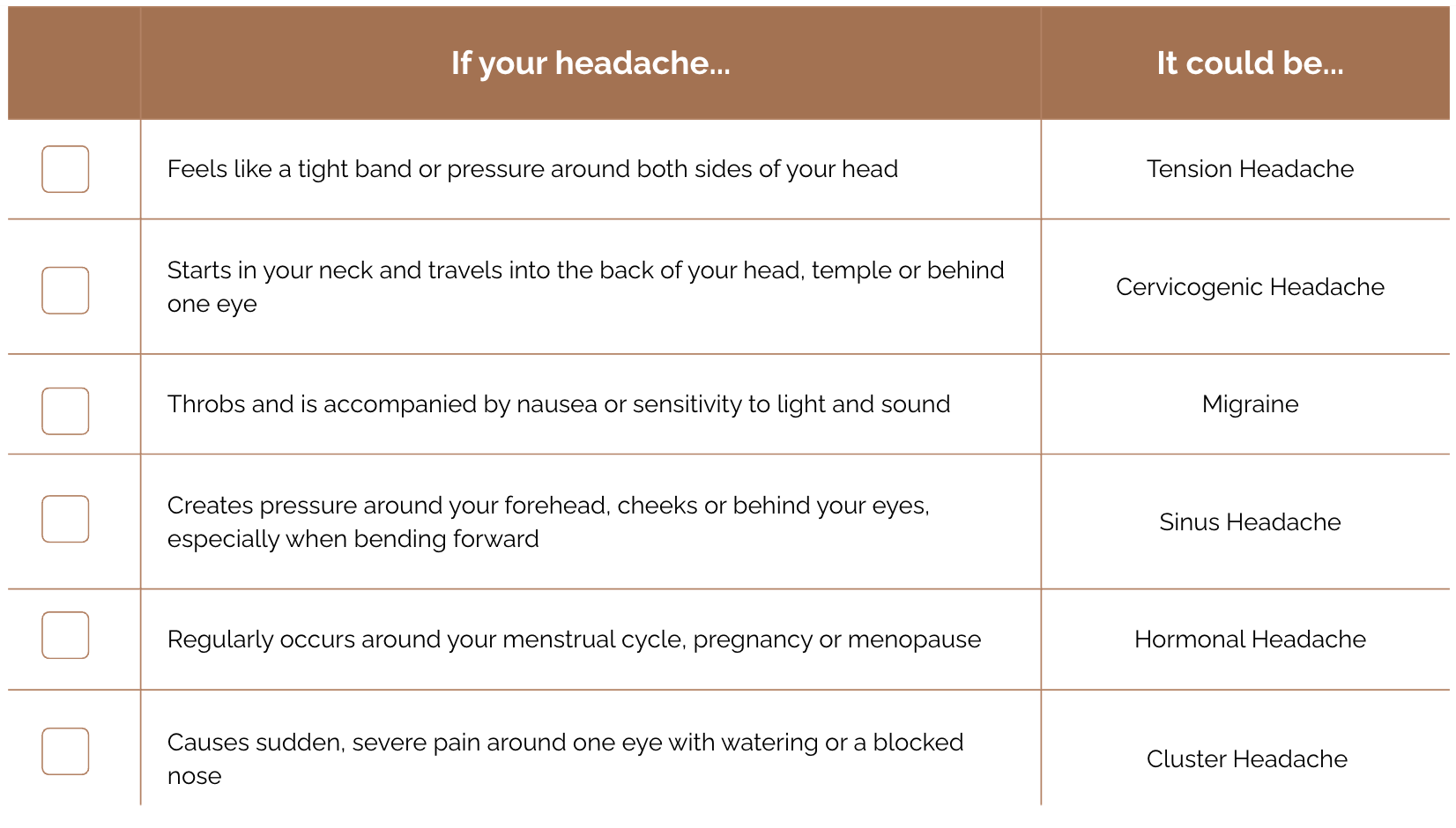
Remember, headaches don't always fit neatly into one category. Some people experience more than one type, and different contributing factors can overlap.
The good news is that understanding the pattern of your headaches is often the first step towards finding the most appropriate management approach.
Now, let's take a closer look at each type.
1. Tension Headaches
The Most Common Type of Headache
If you've ever described your headache as feeling like someone has wrapped a tight band around your head, there's a good chance you've experienced a tension headache.
These are by far the most common type of headache and affect millions of people every year.
Common symptoms include:
A dull, aching pain across both sides of the head
Tightness or pressure around the forehead
Tenderness through the scalp
Tight shoulders and upper back
Neck stiffness
Mild to moderate pain that doesn't usually stop you from functioning
Unlike migraines, tension headaches generally aren't accompanied by nausea or vomiting and are less likely to make you sensitive to light or sound.
What contributes to tension headaches?
Although they're called "tension" headaches, they're rarely caused by just stress alone.
Modern lifestyles place enormous demands on the muscles and joints of the neck and upper back.
Common contributors include:
Long hours working at a computer
Poor workstation setup
Looking down at phones for extended periods
Emotional stress
Jaw clenching or teeth grinding
Poor sleep
Reduced movement throughout the day
Carrying heavy bags on one shoulder
Poor posture over time
As these factors accumulate, the muscles surrounding the neck and shoulders often begin working much harder than they were designed to.
When muscles remain tight for prolonged periods, they can become sore, fatigued and develop sensitive trigger points that refer pain into the head.
At the same time, the joints of the neck and upper back may gradually lose some of their normal movement, further increasing the workload placed on surrounding muscles.
It becomes a cycle.
Reduced movement leads to tighter muscles.
Tighter muscles create more tension.
More tension places greater stress on the nervous system.
Over time, headaches become more frequent.
Where chiropractic may help
One of the first things we assess is how well your neck and upper back are moving.
Healthy joints should move freely through their normal range of motion. When movement becomes restricted, nearby muscles often compensate by working harder to keep the head upright and stable.
Because your head weighs around 4–6 kilograms, even small changes in posture can significantly increase the load placed on these muscles throughout the day.
Forward head posture, rounded shoulders and stiffness through the upper back are common findings in people who experience recurring tension headaches.
Rather than simply focusing on the painful area, chiropractic care looks at the whole mechanical chain.
We assess:
Neck mobility
Upper back movement
Rib movement
Shoulder mechanics
Jaw function
Posture
Daily habits that may be increasing strain
Where appropriate, chiropractic adjustments aim to improve spinal movement, while advice around posture, mobility and strengthening exercises can help reduce unnecessary stress on the surrounding muscles.
Because every muscle in your body is controlled by the nervous system, healthy movement through the spine plays an important role in the quality of communication between your brain and body. When joints become restricted, the surrounding muscles often don't work as efficiently as they're designed to. Improving spinal movement may help optimise these communication pathways, making it easier for your body to move, stabilise and adapt to the physical demands of everyday life.
For many people, it's this combination of improving movement, enhancing nervous system function and addressing the contributing factors that helps them better manage recurring tension headaches.
2. Cervicogenic Headaches
The Headache That Actually Starts in Your Neck
One of the biggest surprises for many people is learning that not every headache begins in the head.
A cervicogenic headache is exactly what its name suggests:
"Cervico" = neck
"Genic" = originating from
In other words, the pain is felt in the head, but the source of the problem may be coming from the structures of the neck.
This is one of the reasons why a thorough assessment is so important. Many people spend months or even years trying to manage head pain without realising the neck may be playing a role.
Common symptoms include:
Pain beginning at the base of the skull
Pain that travels into the temple or behind one eye
Usually affecting one side more than the other
Neck stiffness or reduced range of movement
Pain when turning the head
Headaches that worsen after long periods sitting at a desk or looking down
Pain after sleeping in an awkward position
Headaches following a previous whiplash injury, fall or sporting collision
Many people describe these headaches as feeling like they "start in the neck and work their way up."
Why can the neck cause head pain?
The answer lies in the remarkable way your nervous system is wired.
The very top joints of your neck sit incredibly close to the brainstem and contain thousands of specialised sensory receptors. These receptors constantly send information to your brain about:
Head position
Movement
Balance
Muscle tension
Joint position
This information helps your brain coordinate posture, eye movements and overall body awareness.
The nerves from the upper neck also communicate with an area in the brainstem called the trigeminocervical complex—a region where information from the upper neck and the face converges.
Because these pathways overlap, your brain can sometimes interpret irritation or dysfunction in the upper neck as pain being felt in the head, forehead, temple or behind the eye.
This is known as referred pain.
It's one of the reasons neck dysfunction may be associated with headaches in some people, even when they don't initially think their neck is the problem.
Common Contributors
Cervicogenic headaches often develop when the neck has been exposed to repeated stress over time.
Common contributing factors include:
Poor posture
Prolonged desk work
Looking down at phones or tablets
Previous whiplash injuries
Falls
Sporting impacts
Reduced spinal movement
Muscle imbalance
Weak deep neck stabilising muscles
Sometimes these changes occur gradually over many years.
The body adapts so slowly that many people don't notice they've lost neck movement until headaches become more frequent.
Where Chiropractic might help
This is an area where chiropractors commonly assess whether the spine could be contributing to a person's symptoms.
At Langwarrin Family Chiropractic, we carefully assess how each joint of the neck is moving—not just whether it hurts.
We also look at:
Upper cervical movement
Mid-back mobility
Rib movement
Head posture
Shoulder function
Muscle balance
Previous injuries
Daily work habits
If we identify restricted movement or mechanical factors that may be contributing, chiropractic adjustments may help restore movement to those joints as part of an individualised care plan.
Improving spinal movement may also help reduce unnecessary muscle guarding, improve posture and optimise the quality of information travelling from the neck to the brain.
Because when your brain receives clearer movement information from your body, it has a better opportunity to coordinate movement efficiently.
While headaches are rarely caused by just one factor, improving how the neck moves can be an important piece of the puzzle for many people.
3. Migraines
More Than "Just a Bad Headache"
Migraines are often misunderstood.
People sometimes use the word "migraine" to describe any severe headache, but migraines are actually considered a complex neurological condition involving changes within the nervous system.
For those who experience them, migraines can have a significant impact on work, family life and everyday activities.
Common symptoms include:
Moderate to severe throbbing pain
Often affecting one side of the head
Nausea or vomiting
Sensitivity to light
Sensitivity to sound
Sensitivity to smells
Difficulty concentrating
Needing to rest in a quiet, dark room
Some people also experience what's known as an aura before the headache begins.
An aura may include:
Flashing lights
Zigzag lines
Blind spots
Tingling sensations
Temporary difficulty speaking
Not everyone with migraines experiences an aura, but for those who do, it can provide an early warning that a migraine is developing.
What contributes to migraines?
Unlike cervicogenic headaches, migraines don't have one single cause.
Instead, they often involve a combination of genetic, neurological and environmental factors.
Common triggers include:
Hormonal fluctuations
Emotional stress
Poor sleep
Skipping meals
Dehydration
Certain foods or drinks
Bright lights
Strong smells
Changes in weather
Neck tension for some people
Interestingly, many people who experience migraines also report ongoing neck pain or stiffness before, during or after an episode.
Researchers are continuing to investigate the relationship between neck dysfunction and migraines, as the two commonly occur together.
Where Chiropractic may fit
It's important to understand that chiropractic care is not a treatment for migraines themselves.
However, many people living with migraines also have restricted neck movement, poor posture or muscular tension that may place additional stress on the nervous system.
As chiropractors, we assess whether these mechanical factors may be contributing to the overall picture.
If appropriate, improving spinal movement, posture and joint function may help reduce one of the many factors influencing how the body is functioning.
We also spend time educating patients about lifestyle habits that support a healthy nervous system, including movement, posture, sleep, hydration and stress management.
For some people, addressing these contributing factors forms an important part of their broader healthcare plan alongside advice from their GP or specialist.
4. Sinus Headaches
When Pressure Builds in Your Sinuses
Not every headache begins with your muscles, joints or nervous system.
Sometimes the pain you're experiencing is actually related to inflammation within the sinuses.
Your sinuses are air-filled spaces located behind your forehead, cheeks and around your nose. When they become inflamed due to an infection or allergies, pressure can build up, creating pain that feels very similar to a headache.
Common symptoms include:
Pressure around the forehead, cheeks or eyes
Pain that's worse when bending forward
Nasal congestion
Runny nose
Facial tenderness
A feeling of fullness in the face
Often associated with a cold or seasonal allergies
Unlike cervicogenic or tension headaches, sinus headaches are usually accompanied by other sinus symptoms.
If you regularly experience facial pressure alongside congestion or allergy symptoms, it's worth discussing this with your GP to determine the underlying cause.
5. Hormonal Headaches
When Hormones Influence the Nervous System
Many women notice headaches becoming more common at certain stages of life.
Hormonal changes can influence the nervous system and may alter how sensitive the body is to pain.
Hormonal headaches commonly occur:
Around menstruation
During pregnancy
After giving birth
During perimenopause
During menopause
For many women, these headaches resemble migraines and may be accompanied by nausea or sensitivity to light and sound.
Hormones themselves aren't something chiropractic adjustments change.
However, during these stages of life, many women are also dealing with:
Increased stress
Poor sleep
Neck and shoulder tension
Changes in posture
Caring for young children
Long hours feeding or carrying babies
All of these mechanical factors may place additional stress on the spine and nervous system.
As chiropractors, we consider the whole picture when assessing someone's health, recognising that many factors can influence how a person feels.
6. Cluster Headaches
One of the Most Intense Types of Headaches
Cluster headaches are much less common than tension headaches or migraines, but they're often described as one of the most painful headaches a person can experience.
They usually occur in clusters over several weeks before disappearing for months or even years.
Common symptoms include:
Extremely severe pain around one eye
Red or watery eye
Drooping eyelid
Runny or blocked nose
Restlessness during an attack
Episodes lasting between 15 minutes and 3 hours
Unlike migraines, people experiencing cluster headaches often find it difficult to stay still because of the intensity of the pain.
Cluster headaches require medical assessment and management.
If you think you're experiencing cluster headaches, it's important to speak with your GP or healthcare provider for an appropriate diagnosis and treatment plan.
7. Medication Overuse Headaches
When Pain Relief Starts Causing More Pain
This is one of the least recognised headache types.
Ironically, taking pain medication too frequently can sometimes contribute to recurring headaches.
When certain headache medications are used regularly over extended periods, the nervous system can become increasingly sensitive, leading to headaches returning more often.
People often find themselves trapped in a cycle:
Headache → medication → temporary relief → headache returns → more medication.
If you're relying on pain medication frequently for headaches, it's worth discussing this with your GP to determine whether medication overuse could be playing a role.
What Do All These Headaches Have in Common?
Although these headaches all have different causes, they share one important feature.
They all involve the nervous system.
Your brain is constantly receiving information from every part of your body.
This includes signals from your:
Neck
Jaw
Eyes
Inner ears
Muscles
Joints
Spine
These messages help your brain coordinate movement, maintain balance, control posture and respond to the world around you.
When these communication pathways are functioning well, your body is better able to adapt to the physical demands of everyday life.
When movement becomes restricted, muscles become overloaded or posture gradually changes, the information travelling from the body to the brain may also change.
This doesn't mean spinal dysfunction is the cause of every headache.
But it may become one of several factors influencing how your nervous system is functioning.
That's why we believe it's important to look beyond the pain itself.
Why We Look Beyond Where It Hurts
At Langwarrin Family Chiropractic, our goal isn't simply to ask,
"Where does it hurt?"
Instead, we ask,
"Why might your body be struggling to adapt?"
That's a very different conversation.
Rather than focusing solely on the symptom, we assess the systems that influence how your body functions every day.
That includes looking at:
Your posture
Spinal movement
Joint mobility
Previous injuries
Muscle balance
Deep neck stabiliser function
Rib movement
Breathing patterns
Jaw tension
Daily work habits
Sporting activities
Sleep position
Stress on your nervous system
Sometimes the answer is obvious.
Sometimes it's a combination of several small factors that have gradually accumulated over months or years.
Our role is to identify which mechanical and lifestyle factors may be contributing and to help you understand your options moving forward.
When Should You Seek Urgent Medical Attention?
While the vast majority of headaches are not serious, some require immediate medical assessment.
Seek urgent medical attention if you experience:
A sudden, severe headache that feels like the "worst headache of your life"
A headache following significant head trauma
Difficulty speaking
Weakness or numbness
Vision loss or double vision
Confusion or loss of consciousness
Fever with severe neck stiffness
A new headache that develops after the age of 50
A headache that continues to worsen or changes significantly in pattern
If you're ever unsure, it's always safest to seek prompt medical advice.
The Bottom Line
Headaches are incredibly common; but they're also incredibly individual.
Two people may describe having "headaches," yet the underlying contributors can be completely different.
That's why understanding the type of headache you're experiencing matters.
At Langwarrin Family Chiropractic, we take the time to assess more than just where the pain is.
We look at how your spine moves, how your posture influences your body, how your muscles are functioning and how your nervous system is adapting to the physical demands of daily life.
If we identify mechanical factors that may be contributing to your headaches, we'll explain our findings, discuss whether chiropractic care may be appropriate for you and work with you to develop an individualised plan.
And if your presentation suggests your headaches require further medical investigation, we'll always recommend the appropriate next step.
Because our goal isn't simply to help you feel better today.
It's to help you better understand your body, support your nervous system and give you the confidence to move through life with greater comfort, resilience and health.
Ready to Better Understand Your Headaches?
If headaches are becoming a regular part of your week, don't ignore them or simply push through.
A thorough assessment can help identify whether spinal movement, posture or other mechanical factors may be contributing to the bigger picture.
If you'd like to learn more, our team at Langwarrin Family Chiropractic is here to listen, assess your individual situation and help you understand your options.
Because when you understand the "why" behind your headaches, you're in a much better position to take the next step towards better health.