

Lower Back Pain: Could Your Deep Core Be The Missing Piece?
"I've tried stretching… I've been to the gym… I've rested… but my back just keeps going."
It's something we hear almost every day.
Whether you're a new mum lifting your baby, a tradie working long hours on the tools, or someone spending eight hours a day behind a desk, recurring lower back pain can be incredibly frustrating.
Often, people assume their back itself is the problem.
Maybe they've been told they have poor posture.
Maybe they've been strengthening their core.
Maybe they've tried massage, stretching, foam rolling, or simply waiting for it to settle down.
Sometimes these approaches help… but often the pain returns.
Why?
Because many people are trying to strengthen a body that isn't moving or communicating as efficiently as it could.
At Langwarrin Family Chiropractic, we often explain that your lower back doesn't work on its own.
It's part of an incredible system involving your spine, nervous system, pelvis, breathing muscles, hips and deep core. When one part isn't functioning as well as it should, the rest of the body often tries to compensate.
For many people, poor deep core connection isn't the cause of every episode of back pain, but it can certainly be one piece of the puzzle that is often overlooked.
Let's explore why.
More Than Just A Strong Core
When most people hear the word "core", they picture abdominal workouts, planks or six-pack muscles.
In reality, your body's most important stabilising muscles sit much deeper.
Your deep core is made up of four key structures that work together every second of the day:
The diaphragm
The pelvic floor
The transversus abdominis (your body's natural corset)
The multifidus muscles that sit alongside your spine
Together, these muscles create a natural support system for your spine and pelvis.
Before you even lift an arm, take a step or pick up your child, your brain has already instructed these muscles to prepare your body for movement.
It's an incredible system that most of us never think about, until something isn't working quite right.
Movement Is The Language Of The Nervous System
One of the easiest ways to understand your deep core is to think of your brain as the body's control centre.
Every second of every day, millions of messages travel between your brain and your body.
Your brain is constantly asking questions like:
"Where is my pelvis?"
"Is my spine stable?"
"How much support do I need before I bend down?"
"Can I safely lift this weight?"
The answers come from thousands of tiny movement sensors found throughout your muscles, joints and ligaments.
These sensors are constantly sending information back to your brain about how your body is moving.
The more accurate that information is, the easier it is for your brain to coordinate efficient movement.
This is one of the reasons movement is so important.
Healthy joints don't simply allow us to bend and twist, they also provide valuable information to the nervous system about where our body is in space.
Why Joint Movement Matters
Imagine trying to have a conversation with someone while your phone signal keeps cutting in and out.
You'd probably still understand parts of the conversation…
…but you'd miss some of the important details.
Movement throughout the spine and pelvis works in a similar way.
If certain joints aren't moving particularly well, the quality of information travelling from those joints back to the brain may change.
Your body is incredibly adaptable.
Rather than simply stopping you from moving, it often asks nearby muscles to work a little harder instead.
Over time this can lead to:
Muscle tightness
Fatigue
Reduced movement efficiency
Poor movement patterns
Ongoing lower back discomfort
It's not because those muscles are weak.
It's because they're often doing a job they weren't designed to do.
Why Chiropractic Fits Into The Picture
One of the biggest misconceptions about rehabilitation is that strengthening should always come first.
In reality, many people benefit from first improving how their body moves.
At Langwarrin Family Chiropractic, one of the first things we assess isn't just strength.
We assess movement.
We look at how well the spine moves.
How well the pelvis moves.
How the rib cage moves during breathing.
How the hips move.
How the whole body works together.
If movement through these areas is restricted, it may influence how efficiently the surrounding muscles coordinate and stabilise the body.
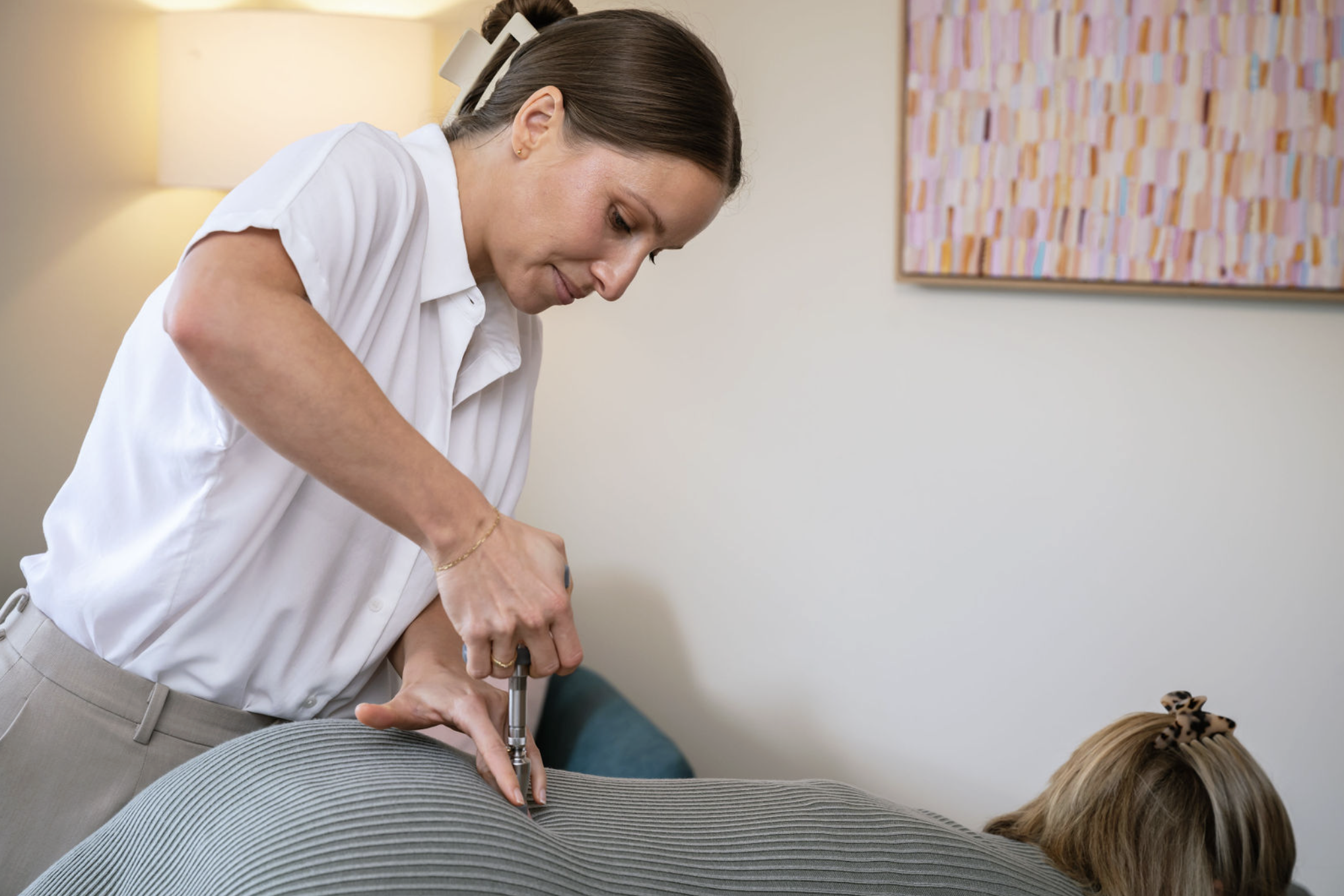
Where appropriate, chiropractic adjustments may be used to help improve joint movement.
Think of it like preparing the foundations before building a house.
If the joints are moving more freely and comfortably, many people find it easier to perform their rehabilitation exercises with better control and awareness.
Adjustments aren't the end goal.
They're often one part of creating an environment where your body can move, stabilise and exercise more efficiently.
That's why, at Langwarrin Family Chiropractic, we rarely stop at "just an adjustment."
Our goal is to combine improved movement with education, rehabilitation exercises and healthy lifestyle habits so your body has the opportunity to function at its best.
Why Doesn't The Deep Core Always Work Properly?
The deep core doesn't work in isolation.
It relies on constant communication between your brain, nervous system, breathing muscles, spine, pelvis and hips.
When one part of this system isn't moving well, another part often compensates.
For example:
Stiff hips may cause your lower back to move more than it should.
Reduced movement through the rib cage can change your breathing mechanics.
A pelvis that isn't moving efficiently may alter how the surrounding muscles coordinate.
Long periods of sitting can reduce movement variety throughout the day.
Previous injuries may lead your body to develop protective movement patterns.
Over time these compensations can make it more difficult for the deep core to do its job effectively.
Instead, larger muscles such as the hip flexors, lower back muscles, glutes or superficial abdominal muscles often work overtime.
This doesn't necessarily mean they're weak.
Often, they're simply overworked.
That's why rehabilitation isn't just about making muscles stronger.
It's about helping the whole system work together again.
Who Is Most Commonly Affected?
Although anyone can experience poor deep core control, there are three groups we commonly see in practice.
Postnatal Women
Pregnancy is one of the most incredible changes the human body can experience.
Over nine months, your body adapts remarkably to make room for a growing baby.
Your abdominal muscles lengthen.
Your centre of gravity shifts.
Your pelvis changes position.
Hormones help prepare your ligaments for birth.
Your breathing pattern changes.
Your pelvic floor works harder than ever before.
After birth, these tissues don't instantly return to how they were beforehand.
While many mums focus on getting "their core back", the first step is often reconnecting with how these muscles work together rather than making them stronger.
Many postnatal women describe:
Persistent lower back pain
Pelvic discomfort
Feeling unstable when lifting their baby
Weakness through the abdomen
Abdominal doming or coning during exercise
Difficulty returning to previous exercise
For many mums, rehabilitation is less about crunches and more about rebuilding coordination between breathing, posture, the pelvic floor and the deep abdominal muscles.
When combined with good movement throughout the spine and pelvis, this can help create a more stable foundation as they return to everyday life.
Desk Workers: Sitting Is Easy... Until It Isn't
For many Australians, the workday now involves spending six, eight or even ten hours sitting.
While sitting itself isn't necessarily harmful, staying in one position for long periods is something our bodies were never designed for.
As adults, many of us spend the majority of our day moving in just one plane, sitting, standing or lying down.
The variety of movement that once kept our joints healthy gradually disappears.
Over time, this can lead to stiffness through the:
Lower back
Mid back
Rib cage
Hips
Shoulders
Neck
As these areas become less mobile, the body often starts finding new ways to accomplish the same movements.
Instead of sharing the workload across multiple joints, one area, often the lower back, begins doing more than its fair share.
This is where many people begin noticing:
Lower back tightness after sitting
Difficulty standing upright after getting out of the car
Aching across the hips
Neck and shoulder tension
Feeling stiff first thing in the morning
Many desk workers think they simply need a stronger core.
Sometimes that's true.
But just as often, they also need their body to move better.
Breathing: The Forgotten Part Of Your Core
One of the biggest changes we see in desk workers is their breathing.
When we're stressed, rushing between meetings or sitting hunched over a computer, many of us begin breathing into our upper chest instead of using our diaphragm.
Remember that the diaphragm is one of the four major muscles of your deep core.
If it isn't moving well because your posture has become rounded or your rib cage has become stiff, your body may have a harder time coordinating the rest of the deep core system.
That's one of the reasons we assess breathing as part of a spinal assessment.
Sometimes improving how your rib cage moves can make breathing feel easier—and create a better foundation for your rehabilitation exercises.
Tradies: Your Body Is Your Toolbox
Tradies ask an enormous amount of their bodies.
Lifting.
Digging.
Carrying.
Twisting.
Climbing ladders.
Working overhead.
Loading trailers.
Pushing wheelbarrows.
It's physical work that places repeated demands on the spine and pelvis.
Ironically, many tradies have very strong muscles—but not always great movement.
Over years of repetitive work, the body often becomes incredibly efficient at using the same movement patterns.
The problem is that efficiency isn't always the same as balance.
If your hips stop contributing as much as they should, your lower back often picks up the extra work.
If your mid back becomes stiff, your neck and shoulders frequently compensate.
If your pelvis isn't moving efficiently, your lower back muscles may stay switched on long after the workday is over.
Many tradies tell us:
"I loosen up once I get moving."
"It's always worse when I stop working."
"Every Monday morning my back is tight again."
These are common experiences when movement quality has gradually changed over time.
Building strength is important—but making sure the body is sharing the workload efficiently is just as important.
Why Exercise Alone Isn't Always Enough
Imagine trying to learn to play the piano with one hand tied behind your back.
You could still practise.
You could still improve.
But it would probably feel much harder than it needed to.
Your body works in a similar way.
If the spine, pelvis, hips or rib cage aren't moving as well as they could, your brain may continue relying on the same compensatory movement patterns—even while you're trying to strengthen your core.
That's why some people spend months doing exercises but still feel like they "can't find their core."
It isn't necessarily because they're doing the exercises incorrectly.
Sometimes their body simply needs a better starting point.
At Langwarrin Family Chiropractic, we often explain that rehabilitation has two important parts.
First, help the body move well.
Then, teach it to control that movement well.
One without the other is often less effective.
How Chiropractic Fits Into Deep Core Rehabilitation
A common question we hear is:
"If my core is weak, why are you looking at my spine?"
The answer is surprisingly simple.
Your muscles don't work independently.
They respond to information coming from your nervous system.
Every joint in your body contains tiny receptors that constantly send information back to your brain about movement and position.
Healthy joints provide healthy movement information.
That information helps your brain coordinate stability before you move.
If movement through the spine, pelvis or rib cage is reduced, it may influence how efficiently the surrounding muscles coordinate.
This is one reason chiropractic care often forms part of a broader rehabilitation plan.
Where appropriate, chiropractic adjustments may help improve joint movement.
Improving movement is not the end goal—it creates an opportunity for better movement quality.
From there, rehabilitation exercises help teach your brain and body how to use that movement more effectively.
That's why we believe adjustments and exercises work so well together.
One helps improve movement.
The other helps your body learn to control that movement.
Think Of It Like Building A House
If you were building a house, you wouldn't start with the roof.
You'd begin with solid foundations.
Your deep core works in much the same way.
Good movement creates the foundation.
Breathing provides pressure control.
Your nervous system coordinates the timing.
Your deep core provides stability.
Only then do larger muscles generate strength and power.
When the foundation is working well, everything built on top of it has the opportunity to work more efficiently.
That's why our care doesn't stop once you're moving better.
Improving movement is simply the beginning.
The next step is teaching your body how to maintain that improvement through specific rehabilitation exercises.
In the next section, we'll walk you through five simple exercises you can begin at home to help reconnect with your deep core, along with some common mistakes to avoid so you can get the most out of each movement.
Five Simple Exercises To Begin Reconnecting With Your Deep Core
Now that we've explored why your deep core matters and how movement throughout the body influences spinal stability, let's look at some simple exercises you can begin at home.
Remember, these exercises aren't about getting a six-pack or working until you're exhausted.
They're about helping your brain and body reconnect with the muscles that provide gentle, everyday support for your spine.
Think of these as quality-over-quantity exercises.
Move slowly.
Breathe normally.
Focus on control rather than effort.
If any exercise causes pain, stop and seek professional advice.
1. Diaphragmatic Breathing
It may sound strange that breathing is the first exercise in a core program—but your diaphragm is one of the most important muscles in your deep core.
Learning to breathe well creates the foundation for everything that follows.
How To Perform
Lie comfortably on your back with your knees bent.
Place one hand on your chest and one on your lower ribs or stomach.
Breathe slowly in through your nose.
Feel your lower ribs gently expand sideways and your abdomen rise naturally.
Slowly breathe out through your mouth.
Allow your body to completely relax before your next breath.
Aim for: 5–10 slow breaths, 2–3 times each day.
Why It Helps
Efficient breathing supports pressure control within your abdomen and encourages the diaphragm, pelvic floor and abdominal muscles to work together.
Watch Out For
Shoulders lifting towards your ears.
Chest rising much more than your lower ribs.
Holding tension through your neck or jaw.
Rushing your breathing.
You Should Feel
A gentle expansion through your lower ribs and abdomen with relaxed shoulders and neck.
2. Gentle Abdominal Brace
This exercise isn't about sucking your tummy in.
It's about gently waking up your body's natural stabilising muscles.
How To Perform
Stay lying on your back with your knees bent.
Imagine you're gently tightening a belt around your waist one notch.
Lightly engage your lower abdomen.
Keep breathing normally.
Hold for 5–10 seconds.
Repeat 10 times.
Why It Helps
This exercise improves awareness of the transversus abdominis, one of the body's deepest abdominal muscles.
Watch Out For
Holding your breath.
Pulling your stomach in as hard as you can.
Flattening your lower back aggressively into the floor.
Tightening your buttocks or thighs.
Feeling pressure pushing down into your pelvis.
You Should Feel
A gentle, even tension around your lower abdomen while breathing remains relaxed.
3. Heel Slides
Now we begin teaching your core to remain stable while your legs move.
How To Perform
Begin lying on your back.
Lightly engage your deep core.
Slowly slide one heel away.
Pause briefly.
Return slowly.
Repeat with the opposite leg.
Aim for 10 repetitions each side.
Why It Helps
Your spine learns to remain stable while your legs move independently.
Watch Out For
Your pelvis rocking.
Your lower back arching excessively.
Your ribs lifting.
Losing your abdominal brace.
You Should Feel
Your trunk remaining steady while your legs move freely.
4. Bird Dog
This is one of our favourite early-stage exercises because it challenges balance, coordination and spinal stability all at once.
How To Perform
Begin on your hands and knees.
Gently engage your core.
Slowly extend one arm and the opposite leg.
Hold for 2–3 seconds.
Return slowly.
Repeat on the other side.
Aim for 8–10 repetitions each side.
Why It Helps
Encourages the deep stabilising muscles of the spine to work together with the hips and shoulders.
Watch Out For
Rotating through your hips.
Arching your lower back.
Holding your breath.
Lifting your leg too high.
Rushing the movement.
You Should Feel
Stable through your trunk while moving with slow control.
5. Glute Bridge
Your glutes and deep core are great teammates.
Strong, coordinated hips help reduce unnecessary strain through the lower back.
How To Perform
Lie on your back with knees bent.
Gently engage your core.
Push through your heels.
Lift your hips until your body forms a straight line from shoulders to knees.
Pause briefly.
Slowly lower.
Aim for 10–15 repetitions.
Why It Helps
Builds strength through the hips while encouraging pelvic stability.
Watch Out For
Arching through your lower back.
Hamstrings cramping.
Pushing with your back instead of your hips.
Ribs flaring upward.
You Should Feel
Your glutes doing most of the work while your lower back stays relatively relaxed.
A Special Note For New Mums
After pregnancy, it's completely normal for your body to feel different.
Your deep core has spent many months adapting to support your growing baby, and rebuilding that coordination takes time.
If you notice any of the following during these exercises:
Doming or coning through the middle of your abdomen
Pelvic heaviness
Pelvic pain
Urinary leakage
Pain around a Caesarean scar
Difficulty controlling your breathing
It may be worth reducing the difficulty of the exercise and seeking individual guidance before progressing further.
Recovery isn't a race.
Building a strong foundation now often supports better movement in the months and years ahead.
Remember... It's About Coordination, Not Just Strength
One of the biggest misconceptions about core training is that stronger always means better.
In reality, your brain is looking for good timing before it looks for maximum strength.
Think of an orchestra.
Every musician might be incredibly talented.
But if they all play at different times, the music doesn't sound right.
Your deep core works in much the same way.
The diaphragm.
The pelvic floor.
The deep abdominal muscles.
The small muscles around your spine.
They all need to work together at the right time.
That's why slowing down and performing these exercises well is far more valuable than rushing through dozens of repetitions.
When Is It Time To Seek Help?
While these exercises are an excellent place to begin, every person moves differently.
Sometimes the missing piece isn't simply strength.
It may be:
Reduced spinal mobility
Reduced pelvic movement
Stiff hips
Limited rib cage movement
Previous injuries
Breathing patterns
Postural habits
Poor movement coordination
At Langwarrin Family Chiropractic, we look at how all of these pieces fit together.
A thorough assessment allows us to understand not just where your pain is—but why your body may be compensating in the first place.
Where appropriate, chiropractic adjustments may be used alongside rehabilitation exercises to help improve joint movement and create a better environment for efficient movement and stability.
Combined with individualised rehabilitation, posture advice and movement education, our goal is to help you move with greater confidence—not just today, but for years to come.
Final Thoughts
Lower back pain is rarely caused by just one thing.
For many people, it's the result of several small factors gradually adding up over time.
Perhaps your hips have become stiff.
Maybe your breathing has changed.
Maybe your spine isn't moving as freely as it once did.
Or perhaps your deep core simply isn't coordinating as efficiently as it could.
The encouraging news is that your body has an incredible capacity to adapt.
By improving movement, restoring confidence in how your body moves and rebuilding deep core control, you can create a stronger foundation for everything else you do.
Whether you're carrying your children, working on the tools, sitting at a desk or simply wanting to stay active as you get older, investing in how your body moves today may help support the life you want to live tomorrow.
Ready To Learn More?
If you've been experiencing recurring lower back pain and feel like you've tried everything without lasting success, perhaps it's time to look a little deeper.
Our chiropractors at Langwarrin Family Chiropractic take the time to assess your posture, spinal movement, breathing patterns, pelvic function and deep core control to understand how your body is working as a whole.
From there, we'll work with you to create an individualised plan that may include chiropractic care, rehabilitation exercises, movement advice and practical strategies you can use at home.
Because when your body moves well, life simply feels easier.
We'd love to help you get started.